
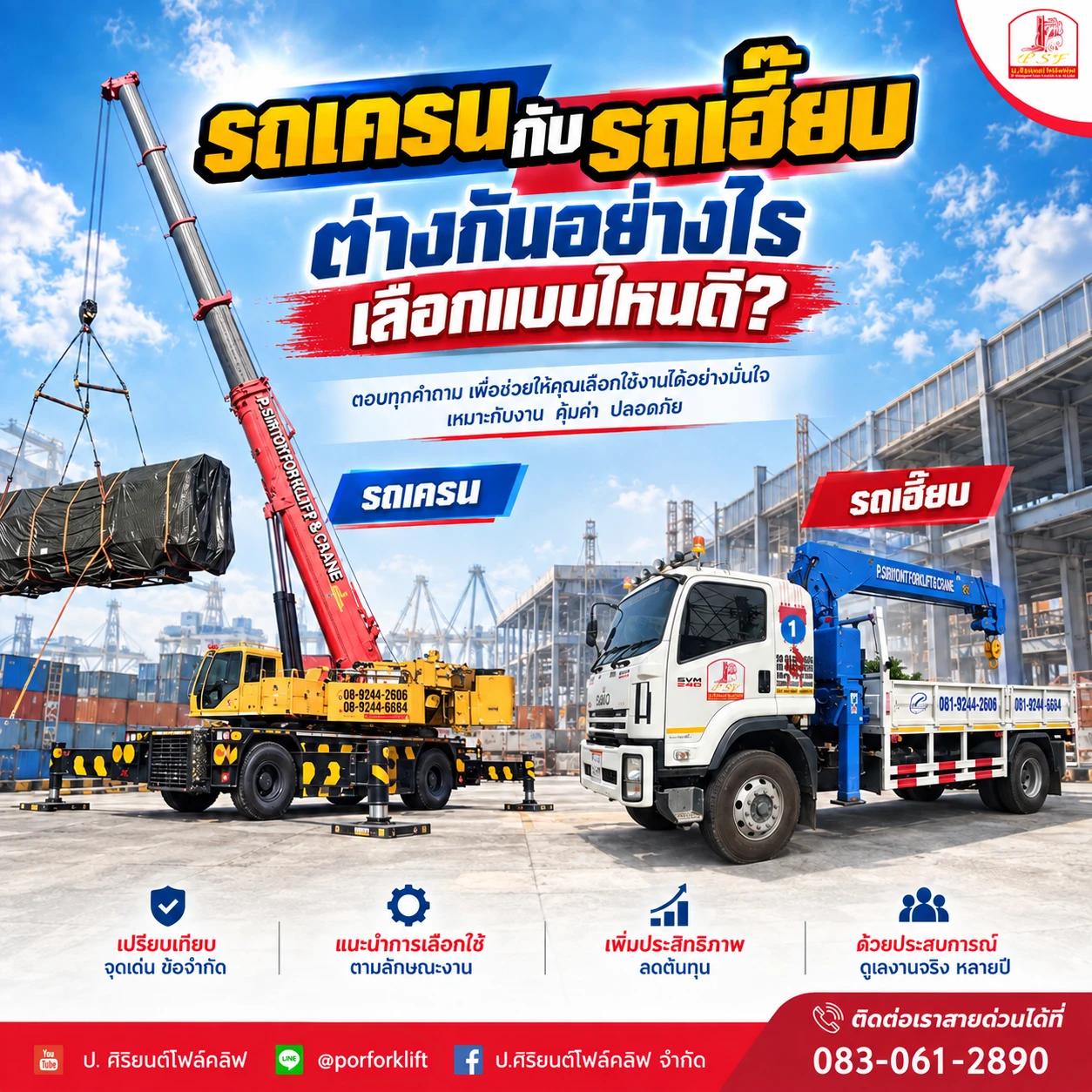
Crane vs. Truck Loader Crane: What’s the Difference? The Key Is How the Job Needs to Be Lifted and Transported
Cranes and truck loader cranes can both be used for lifting, but their primary functions and operating configurations are different. A crane is primarily designed for lifting operations and should be selected based on load weight, working radius, lift height, and crane configuration. A truck loader crane combines a truck body with a mounted crane, making it suitable for jobs where the load needs to be transported as well as lifted onto or off the vehicle.
Therefore, deciding whether to use a crane or a truck loader crane should not be based on load weight alone. Consider whether the job mainly requires “lifting” or “lifting with transportation,” as well as the lifting radius, crane setup area, load dimensions, transportation route, and jobsite limitations.
A crane is primarily used for lifting and is suitable for machinery lifting, equipment installation, construction, and jobs requiring specific boom reach or lift height. A truck loader crane is a truck fitted with a crane, allowing the load to be lifted onto the truck, transported to another location, and unloaded using the same vehicle.
The selection should consider load weight + lifting radius + lift height + setup area + transportation requirements + access route together.
Understanding Cranes and Truck Loader Cranes Before Choosing
Designed Mainly for Lifting and Installation
A crane is lifting equipment with a boom that allows loads to be reached at specific radii and heights. Crane selection should refer to the Load Chart for the particular crane model together with load weight, Working Radius, Boom Length, and crane setup configuration.
- Machinery lifting
- Structural or equipment installation
- Construction lifting
- Factory and industrial project lifting
- Jobs requiring evaluation of lifting radius and height
A Truck-Mounted Crane for Lifting and Transportation
A truck loader crane is a truck equipped with a crane mounted on the vehicle. It can pick up a load, transport it to the destination, and use the onboard crane to load or unload the item. It is suitable for jobs that combine transportation and lifting in the same workflow.
- Pickup and delivery of machinery or equipment
- Transporting materials with loading and unloading
- Delivering equipment directly to jobsites
- Jobs where separate transport and lifting vehicles may not be required
- Applications within the lifting and operating limits of the vehicle
Crane vs. Truck Loader Crane Comparison Table
The following table provides a general comparison. Actual equipment selection should still be based on the vehicle specifications, load weight, lifting radius, and jobsite conditions.
| Factor | Crane | Truck Loader Crane |
|---|---|---|
| Primary function | Lifting and installation | Transportation combined with lifting |
| Load transportation | A separate transport vehicle may be required depending on the job | Includes a truck body for transporting the load |
| Equipment selection | Consider load weight, Working Radius, Boom Length, Lift Height, and Load Chart | Consider load weight, load dimensions, lifting radius, setup area, and payload capacity |
| Typical applications | Machinery lifting, structural installation, construction, and factory lifting | Pickup and delivery of machinery, materials, or equipment requiring loading and unloading |
| Key site considerations | Crane setup area, outrigger space, lifting radius, and lift height | Setup area, lifting radius, truck bed space, transport route, and loading/unloading points |
| Best suited for | Jobs where the main requirement is “lifting” | Jobs where the main requirement is “transportation with lifting” |
When Should You Use a Crane, and When Is a Truck Loader Crane More Suitable?
Lifting Machinery Into Position
If the main objective is to lift machinery from one point and place it in a specific installation position, especially where lifting radius or height must be considered, the crane should be assessed according to the load weight and the crane’s Load Chart.
Picking Up Machinery and Transporting It to Another Location
If the job requires picking up a load, transporting it to another location, and loading or unloading it from the same vehicle, a truck loader crane may better match the workflow because the truck body and crane are integrated into one vehicle.
Lifting Over Obstacles or Reaching a Distant Position
Jobs that require lifting over buildings, machinery, or other obstacles should be evaluated based on Working Radius, Boom Length, and lift height. These factors are important when selecting crane capacity.
Delivering Materials and Unloading Them at the Jobsite
When materials or equipment need to be transported to a jobsite and unloaded upon arrival, a truck loader crane can combine loading, transportation, and unloading within one equipment type, provided the work remains within the vehicle’s rated limits.
Why Is a Crane Suitable for Jobs That Require Evaluation of Lifting Radius and Height?
For crane operations, load weight alone is not enough to determine the required crane capacity. The crane setup position, distance between the crane and load, lift height, boom length, and outrigger configuration can all affect lifting capacity.
For example, two loads with the same weight may require different crane capacities if one lifting point is close to the crane and the other is positioned much farther away.
For more information, read What Is a Crane Load Chart? How to Read It Before Choosing the Right Crane Capacity
Why Is a Truck Loader Crane Suitable for Jobs That Combine Lifting and Transportation?
A key feature of a truck loader crane is that it combines a truck body with an onboard crane. This makes it suitable for transporting materials or machinery from the pickup location to the destination while also using the crane to load and unload the item.
However, the lifting capacity of a truck loader crane still depends on the vehicle model, lifting radius, boom extension, setup configuration, and load characteristics. It should not be selected based on load weight alone.
If the load is large, heavy, or must be lifted at a greater radius, it may be necessary to assess whether a different truck loader crane, a mobile crane, or separate transportation and lifting equipment is required.
Some Jobs May Require Both a Crane and Separate Transportation Equipment
Not every project can be handled simply by choosing between a crane and a truck loader crane. Some projects involve large or heavy machinery that may require a separate transport vehicle for relocation and a crane for loading, unloading, or installation at the jobsite.
For large machinery transportation, a lowbed trailer may be used together with a crane or other lifting equipment depending on the machinery dimensions, weight, and transport route. In some cases, loading and unloading may also require a crane, truck loader crane, or forklift.
Not Sure Whether You Need a Crane or Truck Loader Crane? Prepare These 6 Details
Instead of starting with “Which vehicle do I need?”, begin with the actual job requirements. This information makes it easier to assess the equipment type and capacity according to the real operating conditions.
Provide the actual weight or reliable weight information
Width × length × height, together with photos if available
Provide the pickup and destination locations if the load must be transported
Provide the vehicle setup point, pickup point, and final placement point
Include access routes, setup space, obstacles, and ground conditions
Provide the location, date, and expected working period
Summary: Choose Between a Crane and Truck Loader Crane Based on the Job, Not Load Weight Alone
If you are asking what the difference is between a crane and a truck loader crane, the basic answer is that a crane is mainly used for “lifting,” while a truck loader crane is designed for “transportation with lifting.” Actual equipment selection, however, requires more than identifying the equipment category.
Consider the load weight and dimensions, lifting radius, lift height, setup position, transportation requirements, jobsite conditions, and technical specifications of the actual equipment.
If the job requires evaluation of Working Radius, Boom Length, and a Load Chart, a crane should be assessed in more detail. If the job involves picking up and delivering materials or machinery while loading and unloading them with the same vehicle, a truck loader crane may better match the application.
Frequently Asked Questions About Cranes and Truck Loader Cranes
Not Sure Whether You Need a Crane or Truck Loader Crane?
Send the load weight and dimensions, pickup and placement points, lifting radius, lift height, jobsite photos, and information about whether the load needs to be transported to another location. Por Siriyont Forklift can use these details to assess the equipment type and capacity for the jobsite.