What Are the Main Types of Aerial Work Platforms? Choose by How You Need to Reach the Work Area, Not Height Alone
An aerial work platform is a general term for equipment designed to elevate personnel to work at height. Different types have different movement patterns, outreach capabilities, platform sizes, and operating limitations. For this reason, there is no single fixed number of aerial work platform types that applies to every manufacturer or classification system.
Common types include Boom Lifts, Scissor Lifts, Vertical Mast Lifts, and truck-mounted aerial platforms. Boom Lifts can also be divided into types such as Articulating Boom Lifts and Telescopic Boom Lifts.
Aerial work platforms can be classified in several ways according to their structure and how they reach the work area. Common types include Boom Lifts, Scissor Lifts, Vertical Mast Lifts, and Truck-Mounted Aerial Platforms. Boom Lifts can also be divided into straight-boom and articulated-boom configurations.
Selection should not be based only on “how many meters high” the work is. Consider the height of the work point + horizontal outreach + obstacles + machine setup area + ground conditions + access route + number of workers and equipment on the platform.
What Are the Common Types of Aerial Work Platforms?
Boom Lift – Aerial Platform with a Boom
A Boom Lift uses a boom to position the platform at the required working point. Its main advantage is the ability to provide outreach in addition to vertical elevation, making it suitable when the work point is away from the machine setup position or when obstacles are located between the machine and the work area.
- Building maintenance
- System and equipment installation
- Factory structural work
- Sign installation
- Jobs requiring access over obstacles
Scissor Lift – Vertical Platform Lift
A Scissor Lift raises its platform vertically using a scissor-style lifting mechanism. It is suitable for jobs where the machine can be positioned directly below or close to the working point and where significant horizontal outreach is not required.
- Indoor building services
- Electrical and lighting work
- Warehouse operations
- Ceiling installation
- Jobs requiring platform space for workers and equipment
Vertical Mast Lift – Compact Vertical Access Equipment
A Vertical Mast Lift is compact equipment designed to elevate personnel vertically. It is suitable for indoor work or locations with restrictions on width, access, or maneuvering space.
- Indoor maintenance
- Buildings and shopping centers
- Overhead system work
- Narrow aisles or restricted access areas
Truck-Mounted Aerial Platform
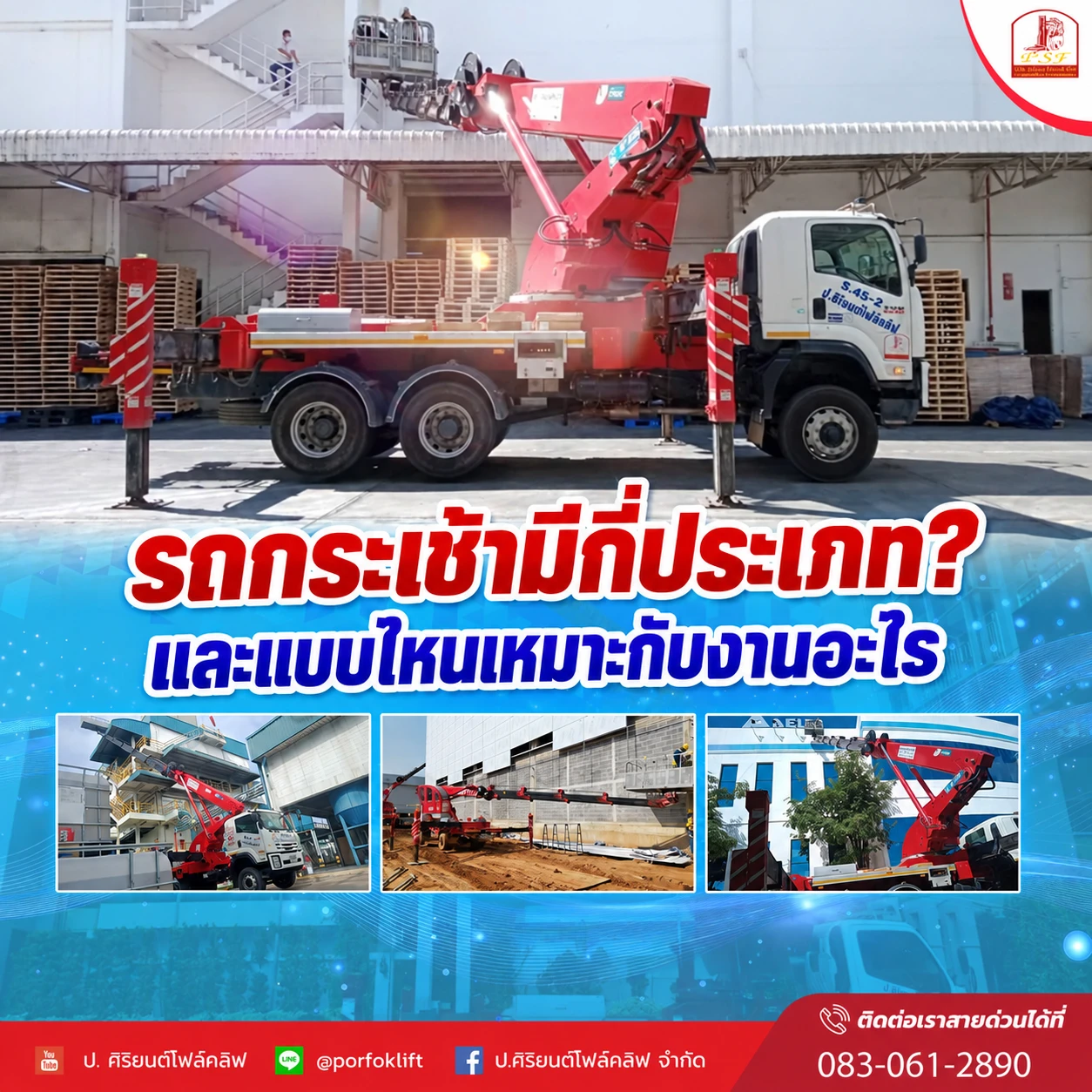
A Truck-Mounted Aerial Platform is an elevated work platform installed on a truck chassis. It is suitable for jobs that require movement between multiple work locations. Working height, outreach, vehicle setup position, and outrigger space should be checked according to the specific vehicle model.
- Electrical system work
- Signage and exterior building work
- Maintenance at multiple locations
- Jobs requiring frequent movement between work areas
What Is the Difference Between an Articulating Boom Lift and a Telescopic Boom Lift?
Articulated Boom for Reaching Up and Over Obstacles
An Articulating Boom Lift has articulated joints along the boom, allowing the platform to approach the work area from different directions. It is suitable when the operator needs to reach up and over obstacles such as machinery, structures, or parts of a building.
Straight Boom for Extended Outreach
A Telescopic Boom Lift uses a straight extending boom. It is suitable for work that requires relatively direct access to the work point and greater outreach from the machine setup location. The actual reach should always be checked against the Working Envelope of the specific model.
What Is the Difference Between a Boom Lift and a Scissor Lift?
| Factor | Boom Lift | Scissor Lift |
|---|---|---|
| Access direction | Provides vertical elevation and horizontal outreach depending on the boom design | Primarily raises the platform vertically |
| Obstacles | Suitable when the platform must reach toward a work point or over obstacles | Suitable when the machine can be positioned directly below or near the work point |
| Platform space | Depends on the specific model and platform size | Many Scissor Lift models generally provide more platform space for workers and equipment than Boom Lift models |
| Typical applications | Outdoor work, structural work, maintenance, and difficult-to-access locations | Building services, installation, warehouses, and overhead work accessible from below |
| Important specifications | Working Height, Horizontal Outreach, Working Envelope, setup area, and ground conditions | Working Height, Platform Capacity, machine dimensions, access route, and ground conditions |
Which Jobs Are Better Suited to a Boom Lift or a Scissor Lift?
Working Directly Above the Machine at Ceiling Level
If the machine can be positioned directly below the work point and there is no need to reach over obstacles, a Scissor Lift may better match the access requirements.
The Work Point Is Away from the Machine Setup Position
If the machine cannot be positioned directly below the work point and the platform must reach from the setup area to another location, consider a Boom Lift and check the required Horizontal Outreach.
Pipes, Machinery, or Structures Block Direct Access
If the platform must reach above or behind obstacles, an Articulating Boom Lift may better suit the access route because its articulated boom can change direction around obstructions.
Multiple Workers and Tools Are Required on the Platform
Check the Platform Capacity and platform dimensions of the specific machine before selection. The decision should not be based on equipment type alone, even though many Scissor Lift models provide comparatively large working platforms.
What Should You Check Before Choosing an Aerial Work Platform?
Simply stating that “the work point is 20 meters high” is not enough to select the equipment. The work point may be directly above the machine, positioned horizontally away from it, or blocked by obstacles between the setup area and the working location.
Identify the actual level the operator needs to reach
Measure the horizontal distance from the machine setup position to the work point when the machine cannot be positioned directly below it
Check for pipes, machinery, roofs, structures, or other objects that may block access
Consider levelness, ground strength, slope, and site requirements
Check doorway width and height, access routes, turning space, and available setup area
Include workers, tools, and equipment while remaining within the rated Platform Capacity of the machine
Why Is Choosing by “Height” Alone Not Enough?
One common reason an aerial work platform may not match the job is selecting it based only on height. For example, the height of the work point may be known, but the horizontal distance between the available machine setup area and the work location has not been measured.
If the machine can be positioned directly below the work point, vertical elevation may be sufficient. However, if machinery, a building, roof structure, or restricted area prevents the machine from being positioned below the work point, horizontal outreach must also be considered.
For Boom Lifts, check the Working Height, Horizontal Outreach, and Working Envelope of the specific model. The maximum height figure should not be interpreted as meaning that the platform can reach every point horizontally at the same height.
Are Working Height and Platform Height the Same?
Working Height and Platform Height should not automatically be treated as the same measurement because definitions and specification methods may vary by manufacturer and market.
Before selecting equipment, confirm whether the stated specification refers to the platform elevation itself or to a calculated working height above the platform. This helps avoid misunderstanding the actual access height.
How Do Ground Conditions Affect Aerial Work Platform Selection?
Equipment used indoors on a smooth factory floor may require different specifications from equipment used outdoors on soil, uneven surfaces, or other challenging terrain. Differences may include tires, drive system, machine dimensions, and allowable slope.
Provide information about whether the work is indoors or outdoors, together with jobsite photos, the machine setup area, and access route so the equipment model can be assessed against the actual site conditions.
Por Siriyont Forklift provides aerial work platform rental services . You can provide the work height, required outreach, jobsite photos, ground conditions, access dimensions, and job requirements so the equipment type and size can be considered according to the site conditions.
This article is intended to explain the main types of aerial work platforms and basic selection principles. The actual machine model and rated specifications for a job should always be checked against the specific equipment that will be used on site.
Summary: Choose a Boom Lift or Scissor Lift Based on How You Need to Reach the Work Point
When asking how many types of aerial work platforms there are, the answer is that they can be classified in several ways, and there is no single fixed number. Common types include Boom Lifts, Scissor Lifts, Vertical Mast Lifts, and Truck-Mounted Aerial Platforms.
For the most common comparison, Scissor Lifts primarily provide vertical elevation, while Boom Lifts are used when both height and outreach are required, especially where obstacles prevent the machine from being positioned directly below the work point.
Before choosing equipment, consider the working height, horizontal outreach, obstacles, access route, setup area, ground conditions, Platform Capacity, and specifications of the actual machine model.
Frequently Asked Questions About Types of Aerial Work Platforms
Not Sure Which Type of Aerial Work Platform You Need?
Send the work height, required outreach, jobsite photos, obstacles, access dimensions, ground conditions, and required working date to Por Siriyont Forklift so the information can be used to assess the equipment type and size for the jobsite.